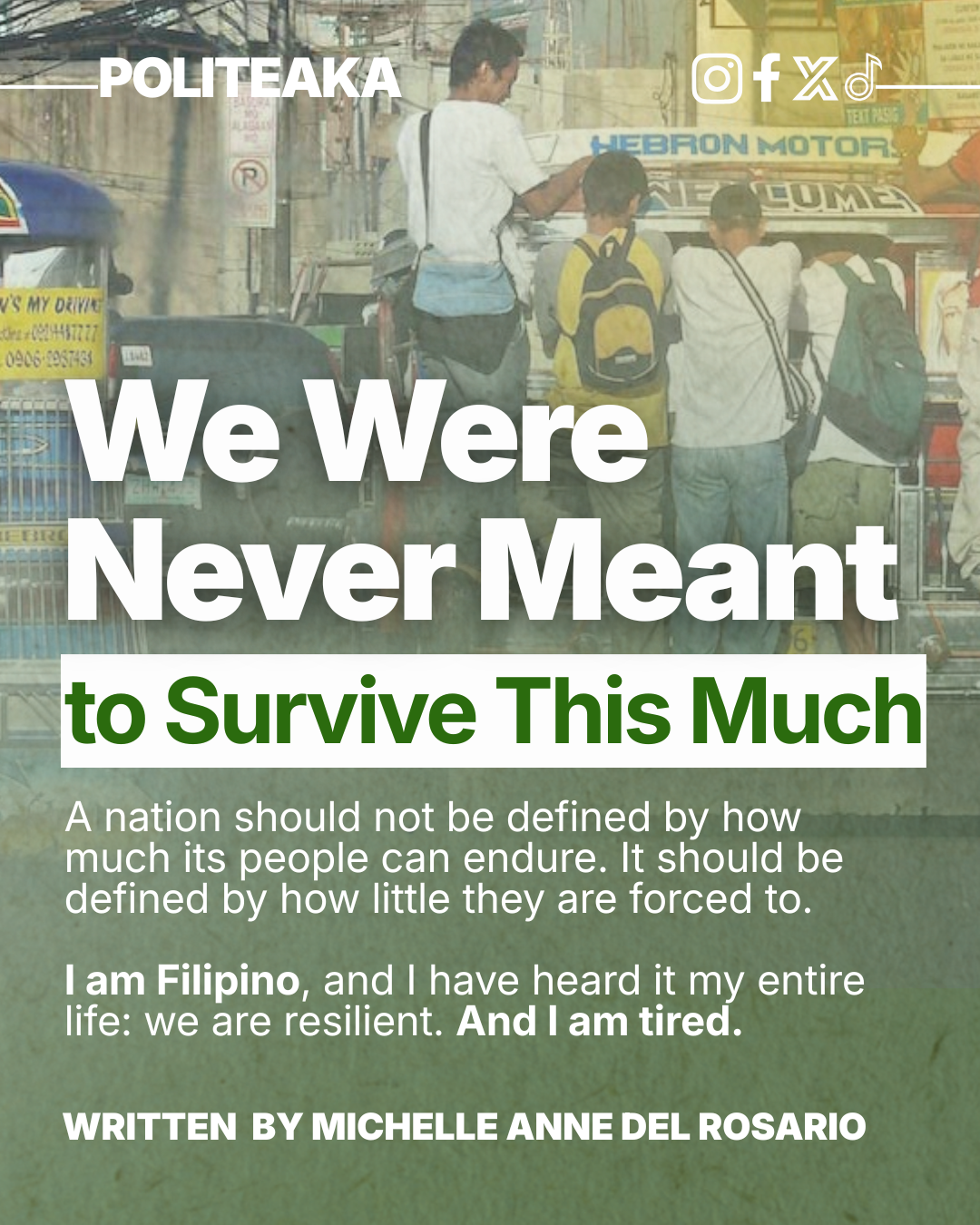
I am Filipino, and I have heard it my entire life: we are resilient. It is said with pride, admiration, sometimes even comfort. But the more I hear it, the more it feels like something else. Not praise, but permission. Permission for systems to remain broken, for institutions to fall short, and for suffering to be expected, managed, and quietly endured.
We repeat it after every typhoon, every flood, every crisis. In classrooms, in news reports, in speeches, it becomes automatic: Filipinos are resilient. It is meant to honor strength. But over time, it softens urgency and redirects attention away from accountability.
Consider what Filipinos are expected to endure. Students wake before dawn and travel hours through unreliable, underfunded transportation systems just to attend class. Workers stretch wages across rent, food, and rising utilities that no longer reflect real income levels. Families rebuild homes after disasters with limited long-term protection. Commuters normalize exhaustion. Patients wait in overcrowded public hospitals where access depends on endurance. Young professionals leave not only out of ambition, but necessity.
These are not isolated stories. They are structural patterns. And yet, instead of outrage, what follows is admiration. We celebrate the student who still graduates, the worker who never complains, the family that rebuilds. Survival becomes admirable. But survival was never meant to be the standard.
Behind every act of resilience is a system that failed to prevent the struggle in the first place. A fragmented and underinvested transportation system where long commutes are normalized. An economy where wages are consistently outpaced by the cost of living. A healthcare system where access depends on time, patience, or connection. A disaster response model that rebuilds after loss, but does not consistently prevent it. These are not temporary gaps. They are structural conditions.
Yet these conditions rarely become the center of the conversation. Instead, we return to the same line: Filipinos are resilient.
This is where resilience becomes dangerous. Not because resilience itself is wrong, but because it has been elevated into a narrative that protects the conditions that make it necessary. When we celebrate endurance, we reduce the urgency to fix what people are enduring. When hardship is framed as strength, it becomes easier to tolerate.
Resilience becomes a cultural and political buffer. It absorbs frustration before it turns into demand and allows broken systems to persist without consequence. A resilient population is easier to manage than a demanding one. If people can adjust and endure, institutions are not forced to respond.
The burden shifts from institutions to individuals. This is the injustice of romanticized resilience. Responsibility is transferred. The student is told to try harder instead of fixing access to education. The worker is told to be resourceful instead of addressing wage stagnation. Communities are told to rebuild instead of asking why they were left vulnerable.
Over time, resilience stops being empowering. It becomes exhausting. To be resilient is to constantly adjust to instability and navigate systems that do not fully support you. That is not strength. That is structural burden.
Filipinos deserve more than the ability to endure. We deserve systems that function without requiring extraordinary effort just to access basic needs. Transportation that is efficient. Wages that keep pace with the cost of living. Healthcare that is accessible, not conditional. Disaster preparedness that protects before loss.
Resilience should be reserved for moments of crisis. It should not be the default condition of everyday life. Because if resilience is always required, then failure is always present.
At some point, we have to ask harder questions. Not just how Filipinos survive, but why survival has become the expectation. Not just how we recover, but why the same conditions continue to repeat. We have normalized hardship as character instead of recognizing it as policy failure.
Because a nation should not be defined by how much its people can endure. It should be defined by how little they are forced to.
I am Filipino, and I have heard it my entire life: we are resilient. And I am tired.