You Don’t Lack Feelings. You Lack the Space to Feel Them
Sa Pilipinas, mas okay na pag-usapan ang mental health ngayon.
Mas maraming nagsasabi: “Hindi ako okay.”
But even now, there’s something that hasn’t changed.
People don’t break down because they don’t feel anything. They break down because they don’t have the space to feel it.
I remember someone telling me:“I can’t afford to feel overwhelmed.” They said it casually like it was just part of life.
Not because it wasn’t real. But because if they stopped working, everything else would stop too.
Bills wouldn’t pause. Responsibilities wouldn’t wait. People depending on them wouldn’t have a backup. So they kept going. Not because they were okay. Because stopping was never an option.
The System We Actually Built Is A Rice Cooker
We talk about mental health like it’s personal.
Something to manage. Something to fix. Something to work on internally.
But for many Filipinos, mental health is not just internal. It is the outcome of systems and environments that continuously produce stress, instability, and trauma.
What we’ve built is not just a mental health system.It is a Pressure System.
Think about a rice cooker.
You close the lid. You add heat. You let pressure build - quietly, steadily, out of sight.
From the outside, everything looks fine. But inside, the pressure keeps rising. And unless something releases it, it doesn’t just disappear. It either leaks slowly or it breaks.
A system where people are expected to function under constant pressure and manage the consequences on their own.
Where the heat never turns off. Where the pressure is normalized. And where release is treated as weakness instead of necessity.
So people keep going. Not because they are okay. But because the system was never designed to let them stop.
The Pressure System: Constant Pressure, Limited Support, No Exit
Let’s call it what it is: The Pressure System
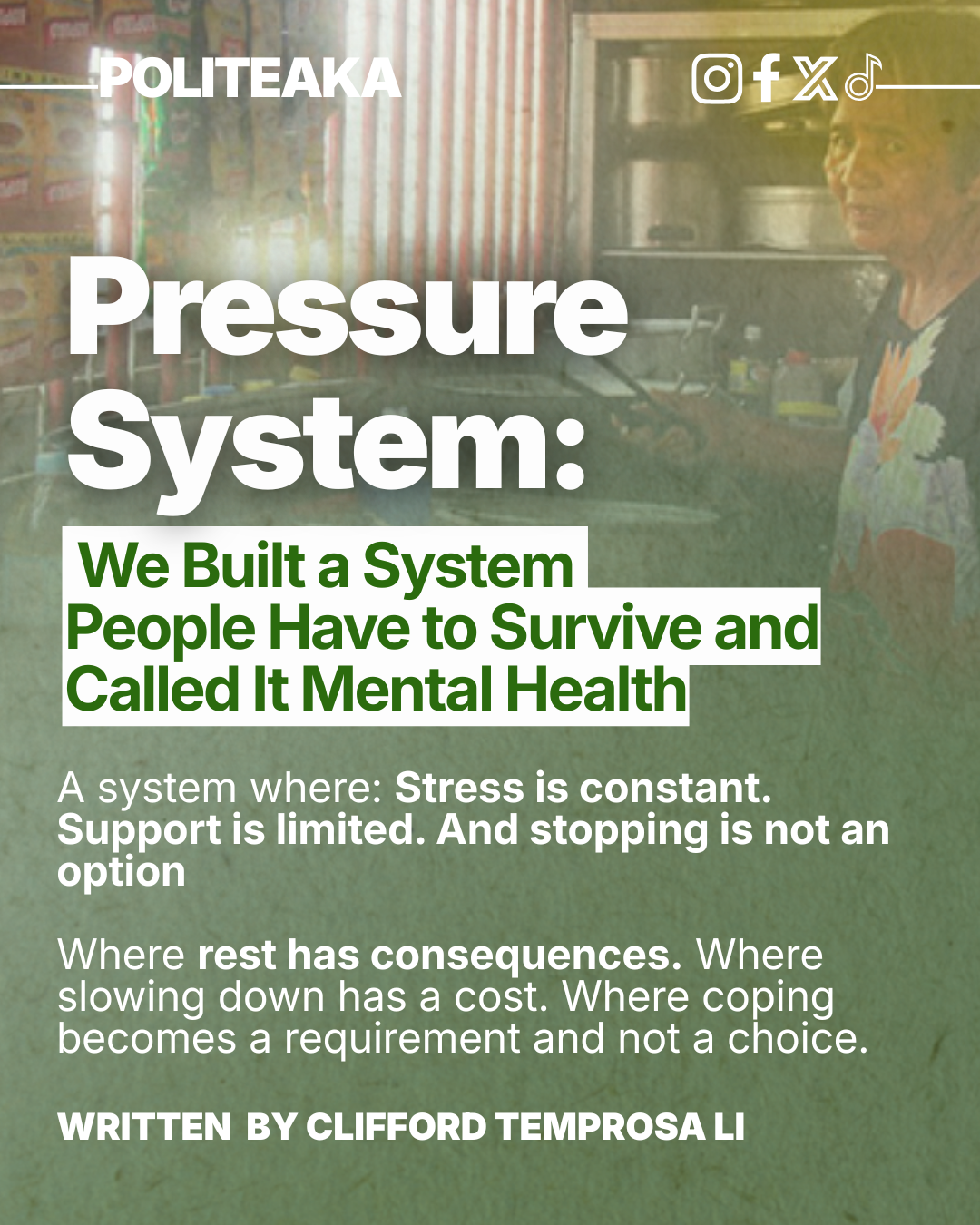
A system where: Stress is constant. Support is limited. And stopping is not an option
Where rest has consequences. Where slowing down has a cost. Where coping becomes a requirement and not a choice.
This is not one issue. It is a condition people are asked to live in every day. This is not about isolated experiences. It is about repeated exposure to structural conditions that produce stress faster than the system can absorb it.
1. Stress Is No Longer Episodic. It Is the Baseline
Stress in the Philippines is not episodic. It is structurally embedded in daily life.
Households operate under continuous economic uncertainty: Irregular income flows, Rising cost of living, Limited financial buffers
This creates a condition of chronic stress exposure where individuals are constantly anticipating risk, even in the absence of immediate crisis.
You wake up already calculating.
If your income will be enough. If your family will be okay. If you can afford to get sick. If your future will be better than your present.
At some point, it stops feeling like stress. It starts feeling normal. But normal does not mean healthy. It means the system has made pressure permanent.
2. Mental Health Is Carried by Households, Not Just Individuals
Mental health burden in the Philippines is not individually contained. It is distributed across households.
This is driven by:
High dependency ratios within families
Limited public welfare coverage
Cultural expectations of intergenerational support
A breadwinner is not supporting one person but an entire household. A child is not just studying but carrying expectations early. An overseas worker is not just earning but managing distance, guilt, and obligation.
This creates multi-layered responsibility structures - expanding both emotional and economic pressure.
Mental health becomes tied not just to personal stability but to the stability of everyone connected to you.
3. Services Exist on Paper. Access Fails in Practice
Mental health services exist. But for many, they remain out of reach.
Barriers include:
High out-of-pocket costs for private care
Capacity constraints in public systems
Geographic concentration of providers in urban areas
Limited availability of culturally responsive services
You look for therapy and see the cost first. You try public systems and face long waits. You search nearby and realize services are not there.
This creates a functional access gap where services exist in theory, but are not reachable in practice. Access exists. But it is not equitable.
4. The System Underproduces and Loses Its Own Workforce
Demand for mental health support is rising.
But supply is constrained by structural bottlenecks:
High cost of education and training
Lengthy licensing processes
Limited compensation relative to training investment
Weak retention mechanisms
This creates a supply-demand imbalance: Low supply → high demand → increased cost → reduced access
And even when professionals are trained, many leave. For better pay. Better systems. More sustainable work. We are losing the talent and capacity to shift the system of trauma.
5. Workplaces Produce Burnout Then Ask You to Manage It
Mental health conversations are happening in workplaces. But conditions remain unchanged.
Long hours.
Low wages.
Job insecurity.
Limited benefits.
Organizations implement wellness programs while maintaining conditions that produce burnout. This reflects a misalignment between intervention and root cause. You cannot solve burnout in the same environment that produces it.
6. Trauma Doesn’t Reset. It Accumulates
The Philippines experiences repeated exposure to large-scale stressors:
Natural disasters
Economic shocks
Public health crises
Each event introduces new stress without fully resolving previous ones.
This results in cumulative trauma accumulation.
But policy responses remain:
Short-term
Reactive
Event-specific
There is limited investment in long-term recovery.So trauma does not reset. It builds.
Mental Health Is Treated as Awareness, Not Infrastructure
Because mental health in the Philippines is still framed as something to talk about not something to build.
Awareness campaigns exist.
Conversations are happening.
People are more open to saying “Hindi ako okay.”
But awareness does not automatically translate into access, and access does not guarantee sustained support.
Policies like the Philippine Mental Health Act exist. On paper, the foundation is there. But systems are not defined by what is written.
They are defined by what is funded, implemented, and sustained. And this is where the gap becomes visible.
Funding remains inconsistent, often dependent on short-term allocations rather than long-term investment.
The workforce remains limited, too few professionals to meet growing demand, with uneven distribution across regions.
Local execution varies, some areas build programs, while others struggle to operationalize even basic services.
So what we have is not a fully built system. It is a partially constructed one.
The system recognizes the issue but does not fully carry it.It acknowledges mental health but does not absorb the conditions that produce it.And when systems don’t absorb pressure that pressure does not disappear.
It moves. And in this case, it moves onto individuals, households, and communities.
All Roads Lead To Trauma
When this gap exists at scale, the outcomes are predictable.
People delay seeking help not because they don’t need it, but because access feels costly, uncertain, or out of reach.
Stress becomes normalized because it is constant, and there is no system strong enough to interrupt it.
People continue functioning but at a cost:
Exhaustion becomes routine
Burnout becomes invisible
Coping becomes silent
Trauma is carried quietly not because it is manageable, but because there is no sustained system to hold it. And over time, this shapes behavior.
People stop expecting support. They adjust to pressure. They internalize what should have been addressed structurally.
Mental health becomes something people manage on their own while continuing to operate within the same conditions that created the strain in the first place. So the issue is no longer just about individual well-being. It becomes about system design.
Because when people are expected to carry what the system does not mental health stops being a personal issue. It becomes a structural outcome.
Collective Healing Demands Intentional Care
If mental health is going to be taken seriously, it cannot remain a conversation.
It cannot be limited to awareness campaigns, short-term programs, or isolated interventions. It has to become infrastructure.
That means systems that are:
Funded consistently
Implemented at scale
Integrated across sectors
Sustained over time
Because mental health is not a one-time issue. It is a condition shaped by how people live, work, and survive every day.
1. Build the Workforce Pipeline
Mental health access cannot expand without increasing supply. Right now, the system is constrained at the entry point.
The cost of education is high. Training pathways are limited. Licensing processes are long and often inaccessible.
This creates a narrow pipeline where only a small number of individuals can enter the field.
To address this, structural barriers need to be reduced.
This includes:
Subsidizing mental health education to lower financial barriers to entry
Streamlining certification and licensing pathways without compromising quality
Developing supervised, paid training models that allow new professionals to gain experience while earning
The goal is not just to produce more professionals….It is to build a scalable, continuous workforce pipeline that can respond to growing demand. Because without supply, access will always remain limited.
2. Retain and Protect Professionals
Expanding the workforce is only effective if professionals stay. Right now, the system loses many of the people it trains.
Compensation is often not competitive. Work conditions can be unsustainable. Career pathways are unclear or limited.
This leads to workforce attrition through migration, career shifts, or burnout. Retention requires building conditions that make staying viable.
This includes:
Establishing competitive compensation frameworks aligned with training investment
Providing incentives for local and community-based service
Creating clear, long-term career progression pathways within the system
Because training professionals is not enough. The system has to keep them. Otherwise, capacity will continue to shrink even as demand grows.
3. Expand Public Mental Health Infrastructure
Mental health cannot remain concentrated in private spaces or urban centers. It has to be embedded into public systems where people already access care.
Right now, access is uneven:
Urban areas have more services
Rural areas have limited or none
Public systems are often overburdened
To close this gap, mental health needs to be integrated into existing health infrastructure.
This includes:
Embedding mental health services into primary healthcare facilities
Expanding barangay-level service delivery to bring care closer to communities
Investing in community-based programs that are culturally responsive and locally accessible
This shifts mental health from a specialized service to a distributed public good that is accessible regardless of geography or income.
4. Regulate Cost and Expand Coverage
Financial barriers remain one of the most immediate constraints to access. Even when services exist, cost determines who can use them.
Out-of-pocket payments remain high. Private care is often unaffordable.Insurance coverage is limited or inconsistent.
To address this, financial protection needs to be built into the system.
Policy interventions should include:
Expanding insurance coverage to include a wider range of mental health services
Standardizing pricing mechanisms to reduce cost variability across providers
Providing targeted subsidies for low-income populations
The objective is to reduce cost-based exclusion so that seeking help is determined by need, not financial capacity.
5. Align Workplace Policy With Mental Health Outcomes
Workplaces are one of the primary environments where mental health is shaped.
But current approaches often focus on surface-level solutions:
Wellness programs
Awareness campaigns
Short-term interventions
Without addressing underlying labor conditions. This creates a gap between what is promoted and what is experienced.
Structural reform requires addressing the root causes of workplace stress.
This includes:
Setting enforceable standards for working hours, rest periods, and workload expectations
Strengthening protections against job insecurity and precarious employment
Establishing accountability mechanisms for employer practices that affect employee well-being.
This shifts the focus from individual coping mechanisms to structural prevention of harm. Because mental health outcomes are directly shaped by labor conditions.
6. Build Mental Health Literacy Systems
Access is not only about availability. It is also about utilization.
Many people do not seek help not because services don’t exist, but because they do not know:
When to seek support
What kind of support is appropriate
How to navigate available systems
This creates delays in care and in many cases, prevents care entirely. To address this, mental health literacy needs to be built systematically.
This includes:
Integrating mental health education into school curricula at multiple levels
Developing community-based education programs that are culturally relevant
Creating clear, accessible pathways that guide individuals through the process of seeking care
This improves early detection, reduces stigma, and increases effective system use.
7. Fund Long-Term Trauma Systems
Mental health systems often respond to crises. But they rarely sustain recovery. Natural disasters, economic shocks, and public health emergencies create long-term psychological impact.
Yet most responses remain:
Short-term
Event-based
Reactive
This creates a cycle where trauma is addressed in moments but not over time. To break this cycle, systems must invest in long-term recovery.
This includes:
Establishing continuous, long-term recovery programs
Building community-based trauma support systems that operate beyond crisis periods
Creating funding models that are sustained—not tied only to specific events
Because trauma does not end when the event does. And without long-term systems, its impact continues to shape individuals and communities long after the crisis has passed.
Mental Health Is the Output of Multiple Levers
These are not separate solutions. They are not independent reforms that can be implemented in isolation. They are components of the same system and that system either works together, or it fails together.
Because mental health does not operate in silos.
It is shaped by how people:
Earn income
Access services
Experience work
Navigate crisis
And recover over time
So addressing one part without the others does not resolve the issue. It redistributes it. Mental health cannot be addressed through isolated programs or temporary interventions. It requires a coordinated system that is designed to function across the full cycle of need.
A system that:
Builds capacity so there are enough professionals and services to meet demand
Protects access so care is not determined by cost, location, or privilege
Sustains recovery so support continues beyond the moment of crisis
And reduces the conditions that produce harm in the first place so fewer people are pushed into survival mode
Because without that level of coordination, the system does not absorb pressure. It transfers it. And when systems transfer pressure, individuals are forced to carry it. That is what we are seeing now.
Mental health is being managed at the individual level not because it belongs there, but because the system has not been built to carry it collectively.
Break the Pressure System
We keep treating mental health as an individual issue.
Something to fix within yourself. Something to manage privately. Something to endure quietly. But the conditions that produce it are not individual. They are systemic. They are built into how people live, work, and survive every day. So the real question is not:
“Are you okay?”
That question assumes the problem starts and ends with the individual. The real question is:
What system are you being asked to survive?
Because when people are expected to cope in environments that continuously produce stress where instability is constant, where support is limited, where recovery is not sustained - then mental health is not just a personal struggle.
It is a predictable outcome of system design. And when outcomes are predictable, they are not accidental. They are produced.
Until we break the Pressure System ….until we build systems that allow people to rest without consequence, to recover without losing stability, and to exist without constant pressure - mental health in the Philippines will remain not just a personal issue, but a structural condition produced, reinforced, and sustained by the system itself.