The Driver Who Never Gets Ahead
Maaga pa. Madilim pa. Nasa terminal na siya. Hindi pa umaandar ang jeep pero nagsimula na ang gastos. Fuel. Boundary. Pagod.
I once spoke to a jeepney driver who told me: ΓÇ£Hindi ako pwedeng hindi bumiyahe. Kahit may sakit.ΓÇ¥
He didnΓÇÖt say it like a complaint. He said it like a routine.
Because in this system, stopping does not pause anything.
No byahe means no kita. No kita means walang pang-boundary. At ang boundary - tuloy lang.
So he drives. Not because he is okay. Because the system continues whether he does or not.
Roads That Were Built To Stall Drivers
We often describe transportation in terms of movement.
Traffic. Routes. Efficiency.
But transport systems are not only defined by how vehicles move. They are shaped by how the people within them sustain themselves.
In the Philippines, mobility depends on drivers who carry the daily cost of keeping the system running.
What weΓÇÖve built is not just a transport system. It is a structure where: Movement is continuous. Income is uncertain. Costs are immediate. Risk is individualized.
At its core, this is a system where operational risk is pushed downward while income stability is not built into the structure.
The route moves. Drivers work within it. Progress does not move at the same pace.
What Shapes The Routes That Drivers Are Forced to Ride
This is not an isolated condition. It is the result of how cost, risk, and reward are distributed across the system.
Every day a jeepney runs, financial pressure is absorbed somewhere. And consistently, that pressure settles at the level of the driver.
1. Income Is Residual. Costs Are Fixed
Jeepney drivers operate within a residual income structure. They do not receive a fixed wage or guaranteed daily earnings. Instead, their income is calculated as what remains after all required costs are paid.
These costs include:
Boundary payments to operators
Fuel expenses that fluctuate daily
Maintenance and repair costs
Operational risks such as low passenger volume or disruptions
This creates a structural imbalance:
This creates a structural imbalance where income remains variable and unpredictable, while costs stay fixed and immediate.
From an economic standpoint, this is a high-risk, low-protection income model with no baseline guarantee.
On days with fewer passengers, heavier traffic, or unexpected delays, earnings decline. But obligations remain unchanged. This forces drivers into a constant position of cost recovery before income generation. Work becomes less about building financial stability and more about maintaining daily viability. Over time, this limits savings, reduces upward mobility, and increases vulnerability to shocks.
2. Waiting Is Work, But It Is Not Valued
A significant portion of a driverΓÇÖs day is spent outside of active driving.
This includes:
Waiting at terminals for passengers
Circulating through routes to reach viable passenger load
Managing timing to optimize trips
This time is essential to system operation. Without it, passenger flow would not stabilize, and routes would not function efficiently. However, this labor is not compensated. It is treated as non-productive time within the income structure.
This creates a disconnect between time spent working and time that generates income
From a labor perspective, this reflects under-recognition of total work input. Drivers extend their working hours to compensate for this gap. Longer hours are not driven by productivity but by the need to reach a viable income level. Over time, this compresses rest periods and contributes to fatigue.
3. Fuel Prices Directly Shape Daily Income
Fuel is one of the largest variable costs in jeepney operations.
Unlike larger transport systems, there is no intermediary layer that absorbs fuel price fluctuations.
When fuel prices increase: Daily operating expenses rise immediately. Take-home income decreases in real time
This creates direct exposure to macroeconomic volatility. There are limited mechanisms to: Delay cost impact. Redistribute price shocks. Stabilize income across fluctuations
As a result, drivers experience economic shifts as daily income reductions, rather than long-term adjustments. This increases financial instability and reduces predictability of earnings.
4. Modernization Without Full Transition Design
Transport modernization efforts aim to improve system efficiency, environmental impact, and fleet quality. However, implementation highlights gaps in transition design.
Drivers are expected to:
Shift to newer units
Participate in cooperative structures
Comply with updated regulatory requirements
But barriers include:
High capital costs for vehicle replacement
Limited access to low-interest financing
Complex application and compliance processes
Uneven institutional support
This creates capital access inequality.Drivers with financial resources or organizational backing are better positioned to transition. Others face increased risk of displacement or exclusion. Without comprehensive transition support, modernization can unintentionally shift risk further onto drivers.
5. Informality Limits Protection
Jeepney drivers operate largely within the informal sector. This limits their integration into formal protection systems.
As a result, access to:
Healthcare
Income protection
Emergency support
Retirement systems
remains inconsistent or unavailable.
When disruptions occur, such as illness, accidents, or economic downturns, there is no structured system to absorb the impact.
Income stops. Costs continue. Recovery depends entirely on individual capacity. This creates high vulnerability to disruption, with limited pathways to stabilization.
6. The System Relies on Overextension
To sustain daily operations within these constraints, drivers extend:
Working hours beyond standard limits. Physical endurance across long shifts. Mental focus under continuous pressure
This leads to cumulative effects:
Fatigue and burnout
Increased health risks
Reduced attention and safety margins
From a systems perspective, this reflects a model dependent on labor overextension for continuity. The system functions but only because individuals continuously stretch beyond sustainable thresholds. This is not built resilience. It is sustained strain.
Pave New Routes. Build RoadsThat Move Drivers Forward
If mobility is going to be sustainable, the system cannot continue to rely on drivers absorbing all of its pressure. It has to be redesigned to stabilize the people who operate within it. That requires shifting from a model built on daily survival toward one that distributes risk, protects income, and sustains long-term participation.
The issue is not that the system does not move. It is that it moves without carrying the people within it forward.
1. Introduce Income-Stabilized Models
At the center of the issue is income instability.
As long as drivers operate within a purely residual income structure, daily earnings will remain unpredictable and vulnerable to external conditions. Addressing this requires introducing compensation models that provide a baseline level of stability. This can take the form of minimum daily income guarantees, revenue-sharing frameworks between operators and drivers, or hybrid models that combine fixed and variable earnings.
The goal is not to eliminate performance-based income entirely, but to ensure that drivers are not starting from zero every day. By establishing an income floor, the system reduces volatility, improves financial planning, and limits the need for extended working hours simply to break even.
2. Build Cost Absorption Mechanisms
A second structural issue is the direct exposure of drivers to cost fluctuations - particularly fuel.
At present, price increases are immediately felt at the driver level, with no intermediary system to absorb or redistribute the impact.
To address this, cost absorption mechanisms need to be built into the system itself. This includes fuel stabilization programs that adjust in real time, as well as fare frameworks that are responsive to changing operating conditions.
More broadly, cost-sharing structures can be developed so that economic shocks are distributed across operators, institutions, and policy mechanisms - rather than concentrated on individual drivers. When cost volatility is absorbed collectively, income stability becomes more achievable.
3. Expand Social Protection Access
Mobility workers should not exist outside of protection systems. Yet for many jeepney drivers, access to healthcare, income protection, and social services remains limited due to informality.
Closing this gap requires integrating drivers into formal social protection frameworks in ways that are accessible and scalable. This includes ensuring consistent access to healthcare coverage, developing income protection mechanisms that activate during periods of disruption, and expanding pathways into existing social welfare systems.
When protection systems are present, disruptions - whether personal or systemic - do not immediately translate into financial crises. Instead, they become manageable events within a broader support structure.
4. Design Inclusive Modernization Pathways
Modernization cannot be treated as a purely technical upgrade. It is also a transition in economic participation.
Without intentional design, modernization risks reinforcing existing inequalities by favoring those with greater access to capital.
Inclusive pathways require financing structures that are realistic for drivers, including subsidized or low-interest options, as well as simplified processes for participation.
At the same time, cooperative and collective ownership models need to be supported in ways that genuinely empower drivers, rather than placing additional administrative burden on them.
The objective is to ensure that modernization does not displace drivers, but instead enables them to remain active participants in a more sustainable system.
5. Recognize Full Labor Inputs
Current compensation structures reflect only a portion of the work drivers perform.
Driving is treated as the primary labor activity, while waiting, queuing, and route circulation are excluded.
In reality, these activities are essential to system function. Recognizing full labor inputs means redefining what counts as work within the system.
When waiting time and operational downtime are acknowledged as part of the labor process, compensation structures can be adjusted to better reflect actual effort. This reduces the pressure to extend working hours and aligns income more closely with the realities of the job.
6. Build Driver-Centered Policy Frameworks
Finally, mobility systems need to be reframed as labor systems - not just infrastructure systems.
Policy design should reflect this by incorporating metrics that track not only movement, but also the conditions of those who sustain it. This includes indicators related to income stability, working hours, health outcomes, and long-term economic mobility.
By embedding these into planning and evaluation processes, the system shifts from measuring efficiency alone to measuring sustainability and equity.
Because mobility is not just about getting people from one place to another. It is about whether the people who make that movement possible are able to build stable lives within it.
When these elements are built together - not in isolation - they begin to change how the system functions.
Income becomes more predictable. Risk becomes more evenly distributed. Work becomes more sustainable over time.
And mobility starts to mean something different. Not just movement across space but movement forward.
Make Movement Lead Somewhere
This does not come from one issue. It comes from how everything is set up to move.
How income is earned. How costs arrive. How risk is carried. How recovery never quite catches up.
Each part connects to the next. And over time, it creates a direction. Not forward. Just continuous. Because in this system, pressure does not disappear. It moves. From policy to operator. From operator to driver. From system to person.
Until it settles somewhere it can no longer move. And most of the time, that is with the driver.
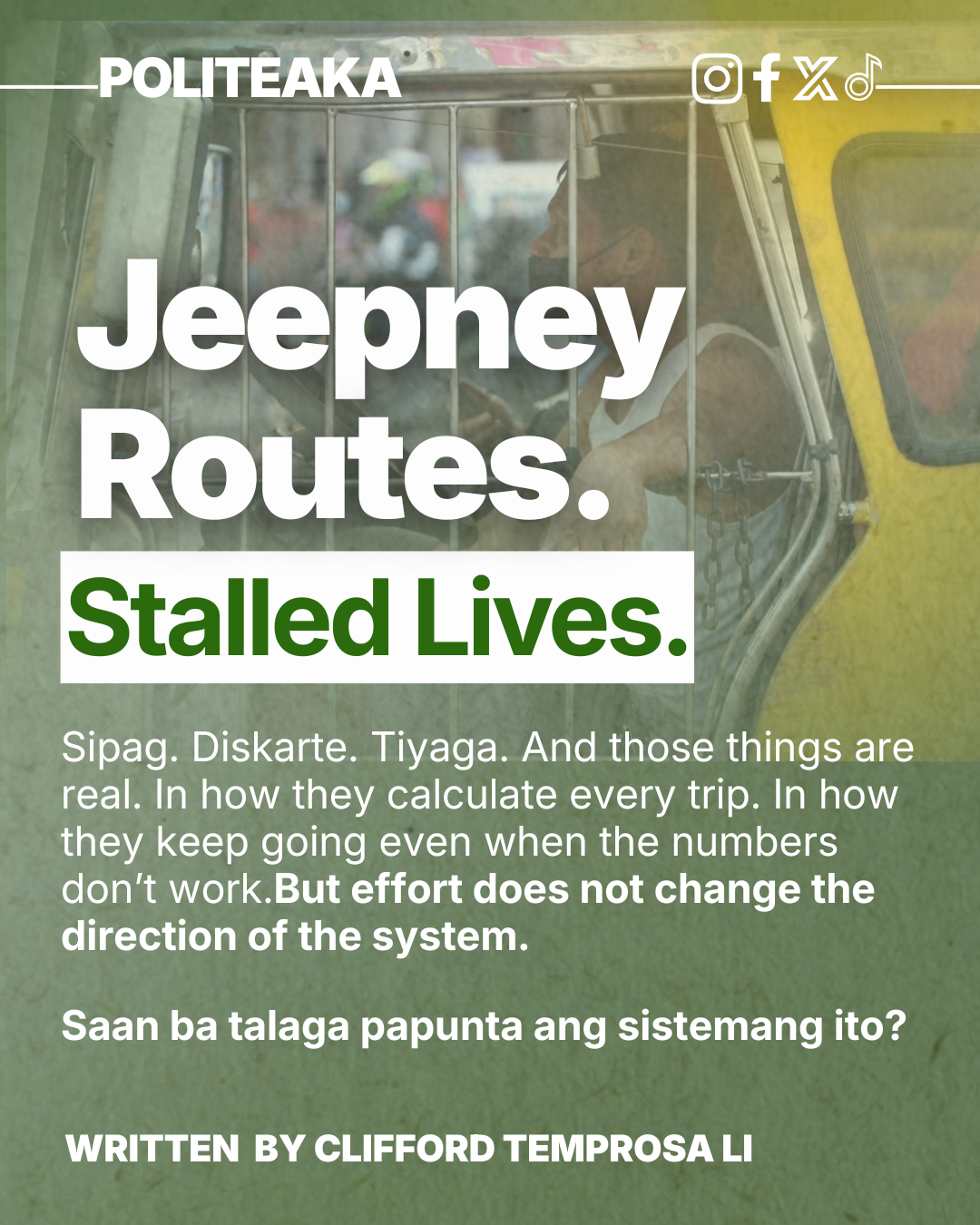
You hear it all the time. Sipag. Diskarte. Tiyaga. And those things are real. You see it in the way drivers extend their day. In how they calculate every trip. In how they keep going even when the numbers donΓÇÖt work.
But effort does not change the direction of the system. So the question is not:
ΓÇ£Kaya ba ng driver?ΓÇ¥
Because drivers already do. Every day. The question is: Saan ba talaga papunta ang sistemang ito?
Because when everything is structured the same way, day after day the outcome stops being a question. It becomes a pattern.
The route is clear. The jeep moves. The day repeats.
Passengers get where they need to go. But for the driver….distance does not turn into progress.
And until the system is built so that movement leads somewhere,jeepney routes will keep running,and the people behind the wheel will keep moving - without ever really getting ahead.