The First Seat at the Table
For many young Filipinos, the SK is the first time they hold power.
First budget. First project. First authority that carries real consequence.
Chairperson. Kagawad. Representative. Titles that signal leadership.
It feels like access.
A chance to lead. A chance to represent. A chance to do something that matters. And for some, it is. But for many, that first experience reveals something deeper. Not just what leadership looks like but how governance actually functions.
How decisions are made. How resources move. How accountability is enforced or not.
Because the first system you enter does not just give you responsibility. It teaches you what responsibility looks like in practice. And more importantly….what it can get away with.
Corruption Starts Young
The SK was designed to empower youth participation.
To build leadership. To develop civic engagement. To prepare the next generation of public servants.
But what it often becomes is something else. An early entry point into the same governance structures that already exist. Not a separate space to learn differently but a smaller version of the same system.
What we’ve built is not just a youth council. It is a system where:
Authority is granted early
Resources are allocated quickly
Oversight is uneven
Expectations are loosely defined
At its core, this is a system where power is given but proof of how it is used is not consistently required.
Responsibility exists. Budgets exist. Programs exist.
But the systems that verify, track, and enforce responsible use do not always exist at the same level. And when those systems are missing, the lesson becomes clear:
Power is real. Accountability is negotiable.
Unchecked Authority: The SK System
Let’s call it what it is:
Unchecked Authority: The SK System
A system where:
Authority is visible but verification is inconsistent
Funds are allocated but traceability is uneven
Participation is encouraged but accountability is not equally enforced
The intention is leadership development. But participation alone does not produce credibility.
Because credibility is not built by holding a position. It is built by systems that make actions visible, decisions traceable, and outcomes accountable.
And when those systems are not consistently present what gets developed is not just leadership. It is a version of power that learns how to operate without being fully checked.
A Breeding Ground for Corruption
The SK system, as it currently operates, does not just allow misuse. It produces the conditions for it.
Not because individuals are inherently corrupt but because the system lowers the cost of misuse, weakens detection, and fails to consistently enforce consequences.
From a governance standpoint, this is not a minor gap. It is a high-risk institutional design.
Where three structural conditions intersect:
Direct access to public funds
Inconsistent or fragmented oversight
Weak and unpredictable enforcement
When these conditions exist together, the outcome is not uncertain.
Discretion expands beyond clear boundaries.
Accountability becomes uneven and negotiable.
Verification becomes inconsistent and delayed.
In that environment, corruption does not need to be introduced.
It emerges.As a possible and repeatable outcome of how the system functions.
That is what makes it dangerous. Because corruption, in this context, does not always begin as intent.
It begins as:
Spending without structured controls
Documentation that is incomplete or inconsistent
Decisions made informally rather than through defined processes
Practices based on precedent instead of policy
At first, these are seen as minor gaps. Over time, they become standard practice. And when that happens, the distinction between proper use and misuse begins to erode. The system stops signaling where the line is. And when the line is unclear, it becomes easier to cross.
This is how corruption becomes normalized. Not through explicit instruction but through the absence of structure, enforcement, and consequence.
And once that normalization takes hold, the system is no longer just vulnerable to corruption. It is capable of reproducing it. That is how systems quietly become breeding grounds for corruption.
What Shapes How SK Actually Functions
1. Budget Authority Without Integrated Financial Control Systems
SK units are given direct authority to manage public funds. That authority is real and immediate.
What is less consistent is the financial infrastructure that should govern how those funds are planned, disbursed, and audited.
In practice, financial management within SK often depends on local interpretation rather than standardized systems. Budgeting processes vary in rigor. Procurement is not always guided by uniform protocols. Documentation is sometimes incomplete, delayed, or difficult to verify in real time.
From a governance standpoint, this reflects a condition of decentralized fiscal authority without integrated financial control systems.
When that happens, financial risk does not appear as a single failure point. It spreads across the entire expenditure cycle.
Funds can be allocated without clear prioritization frameworks. Spending decisions can be made without consistent documentation. Post-implementation reporting may not fully capture how resources were used.
The result is not just vulnerability to misuse. It is a system where prevention, detection, and correction mechanisms are not consistently built into the process.
2. Authority Exceeds Institutional Capacity
SK officials assume leadership roles immediately after election. mBut institutional capacity does not scale at the same speed.
Training, when available, is not always standardized or comprehensive. There is no guaranteed baseline across all SK units for public financial management, governance procedures, or policy design. This creates a structural imbalance. Authority is uniform. Capacity is not.
From an institutional perspective, this reflects capacity lag within decentralized governance systems, where responsibility is assigned before the systems required to carry it are fully developed.
As a result, execution becomes uneven. Decision-making relies heavily on individual initiative rather than institutional support. In some cases, strong leaders compensate for system gaps. In others, those gaps remain unaddressed.
Responsibility exists. But the system does not consistently produce the readiness required to meet it.
3. Fragmented Oversight and Inconsistent Enforcement
Oversight within the SK system is formally present, but functionally uneven.
Monitoring and enforcement are often dependent on the level of engagement of barangay officials, the priorities of local government units, and the administrative capacity available in a given area.
This creates a condition of fragmented accountability architecture. Rules may exist, but their enforcement is not uniform.
In some jurisdictions, oversight is active and structured. In others, it is minimal or reactive. Audits may occur, but not always consistently or in real time. Corrective actions may be taken, but not always predictably.
This variability has structural consequences.
When enforcement is inconsistent, compliance becomes conditional. Standards begin to shift depending on context. Over time, rules function less as constraints and more as flexible guidelines.
And when that happens, the system loses its ability to regulate behavior consistently.
4. Embedded Political Incentives and Early Capture Exposure
The SK system does not operate independently from the broader political environment. It is embedded within it.
This exposes SK officials to existing political dynamics early in their leadership experience. Patronage relationships, political endorsements, and alignment with incumbent officials can influence how decisions are made and how resources are accessed.
From a political economy perspective, this creates conditions for early-stage political capture.
Instead of functioning as an independent training ground for youth leadership, SK can become integrated into existing networks of influence. Decision-making may begin to reflect alignment rather than autonomy. Access to resources may become linked to relationships rather than need.
This does not just affect outcomes. It shapes norms.
Leadership is not only practiced - it is learned within a specific system of incentives. And when those incentives are already influenced by existing power structures, they begin to define how governance is understood from the beginning.
5. Short-Term Mandates Drive Short-Term Behavior
SK terms are limited in duration, and this has direct implications for how governance is practiced.
With limited time, the incentive is to produce visible outputs quickly. Events, programs, and short-term initiatives become the dominant mode of engagement.
Long-term planning becomes more difficult to prioritize. Programs that require continuity across terms are harder to sustain. Documentation and institutional memory are not always carried forward.
From a governance standpoint, this reflects a short-termism problem, where performance is measured through immediate outputs rather than long-term outcomes.
Over time, governance becomes project-based rather than system-based. Each term operates as a standalone cycle. Learning is not always retained. Progress is not always cumulative.
The system moves but it does not always build.
6. Credibility Is Structurally Inconsistent
Credibility within the SK system is not consistently produced.
Not because individuals lack integrity but because the structures that generate credibility are uneven.
Credibility depends on systems that make governance visible and verifiable. It requires consistent documentation, transparent financial tracking, clear implementation records, and enforceable consequences.
When these systems are inconsistent, credibility becomes difficult to establish.
From the outside, it becomes unclear which projects are fully implemented, which funds are properly used, and which decisions are independently made. The distinction between effective governance and performative activity becomes harder to see.
Trust, in this context, becomes generalized rather than evidence-based.
And when trust is generalized, it becomes fragile.
The problem is not that power is given too early. It is that accountability is built too late. And with the wrong intention.
When systems cannot consistently verify actions, they do not just lose credibility they create space where misuse can occur without immediate consequence.
The issue is not that some leaders cannot be trusted. It is that the system does not consistently prove who should be.
7. Discretionary Space Expands Without Clear Boundaries
Authority in SK is real.
Budgets are real. Programs are real. What is less consistent are the boundaries that define how that authority should be exercised.
In many cases, decision-making occurs within high-discretion environments, where processes are loosely structured, documentation is uneven, and oversight is delayed.
This creates conditions where project selection can be influenced by visibility rather than need. Spending patterns may not be fully traceable in real time. Programs may meet formal requirements without delivering substantive impact.
This is not always intentional misuse. It is system-enabled ambiguity. And ambiguity has structural consequences.
When rules are unclear and enforcement is inconsistent, compliance becomes variable. Over time, variability becomes normalization. And when that happens, the system no longer clearly signals where the boundaries are.
Fueling the Cycle of Poor Leaderhsip
Over time, these structural conditions produce consistent outcomes. Participation continues. But governance quality varies. Public trust becomes inconsistent. Leadership development becomes uneven. More importantly, these patterns do not remain contained within SK.
They shape how governance is learned, practiced, and carried forward. Over time, the system does not just tolerate weak accountability. It normalizes it.
And in environments where accountability is weak and verification is inconsistent, corruption does not need to be introduced. It becomes easier to reproduce.
The system begins to teach: Not just how to lead but how to operate within weak structures. And those lessons do not stay at the SK level. They scale.
A Youth Leadership Pipeline Defined By Integrity
If the SK system is meant to function as a genuine leadership pipeline, then responsibility cannot exist without structure.
Right now, authority is distributed faster than the systems required to support, regulate, and verify it. That imbalance is what needs to be corrected. Because governance capacity is not produced by participation alone. It is produced by systems that standardize how decisions are made, how resources are used, and how accountability is enforced.
1. Standardize Financial Governance as a Non-Negotiable System
The management of public funds cannot be left to local interpretation.
It has to operate within a uniform financial governance architecture that defines how resources are planned, allocated, disbursed, and audited across all SK units.
This means institutionalizing binding frameworks for budgeting, procurement, and financial reporting so that compliance is not dependent on local practice, but enforced as a system-wide standard.
More importantly, these frameworks must be supported by digital financial infrastructure that enables real-time visibility and auditability. Financial activity should not rely on retrospective reporting. It should be continuously traceable across the full expenditure cycle.
When financial systems are standardized, digitized, and verifiable, misuse does not simply become less likely. It becomes harder to execute, easier to detect, and more difficult to sustain.
2. Make Governance Capacity a Structural Requirement, Not an Assumption
Leadership within SK should not begin with assumption. It should begin with demonstrated readiness. Governance capacity must be institutionalized as a precondition for holding office, not an optional layer added after authority is granted.
This requires mandatory, standardized training in public financial management, administrative governance, policy design, and ethics that are delivered prior to assumption of office and reinforced throughout the term.
From an institutional standpoint, this establishes a minimum competency threshold across all SK units, reducing reliance on individual initiative and limiting variability in execution.
Because when capacity is uneven, governance outcomes become uneven. And when governance outcomes are uneven, accountability becomes inconsistent.
3. Operationalize Transparency as a Continuous System Function
Transparency cannot remain a periodic compliance exercise. It has to be embedded into the daily operations of governance.
This requires transitioning toward real-time transparency systems, where financial data, project implementation, and decision records are continuously documented, standardized, and publicly accessible.
Through integrated dashboards, uniform reporting protocols, and open disclosure mechanisms, visibility is expanded beyond auditors to include communities, stakeholders, and oversight bodies.
In this model, transparency is no longer reactive. It becomes structural and continuous. And when transparency is continuous, credibility is no longer assumed. It is systematically produced and independently verifiable.
4. Institutionalize Predictable Accountability and Enforcement
Accountability only functions when enforcement is consistent. Right now, variability in oversight weakens the system’s ability to regulate behavior.
What is required is a uniform accountability and enforcement framework that applies across all SK units without exception.
This includes clearly defined standards of misuse, standardized audit protocols, fixed compliance thresholds, and enforceable consequence pathways that are triggered predictably.
From a systems perspective, this restores accountability as a deterministic function, rather than a discretionary one. Because when consequences are uncertain, rules lose their binding force. They stop operating as constraints and begin functioning as optional guidelines.
5. Structurally Insulate Youth Governance From Political Capture
If SK is intended to cultivate independent youth leadership, then its institutional design must actively protect that independence. At present, its integration within existing political ecosystems exposes it to patronage dynamics, influence-based decision-making, and dependency on local political actors.
Addressing this requires establishing clear structural boundaries - both formal and operational - that separate SK governance from local political control. Decision-making authority must be anchored in defined governance processes, not contingent relationships.
From a governance perspective, this reduces the risk of early-stage political capture and prevents the normalization of influence-driven leadership practices. Because if independence is not structurally protected, it cannot be consistently practiced.
6. Design Governance for Continuity, Not Reset
Governance systems should accumulate progress. They should not reset with every election cycle.
At present, SK operates within short-term mandates that prioritize immediate outputs, often at the expense of continuity and long-term impact.
To address this, continuity must be built into the system through formal transition mechanisms, standardized documentation protocols, and multi-term planning frameworks.
This ensures that programs, data, and institutional knowledge are retained and transferred across leadership cycles.
From a systems perspective, this shifts governance from a project-based model to a cumulative institutional model, where learning compounds, and impact is sustained.
Because without continuity, governance remains fragmented. And fragmented governance cannot produce consistent outcomes.
If This Is the System They Learn, This Is the System They Will Run
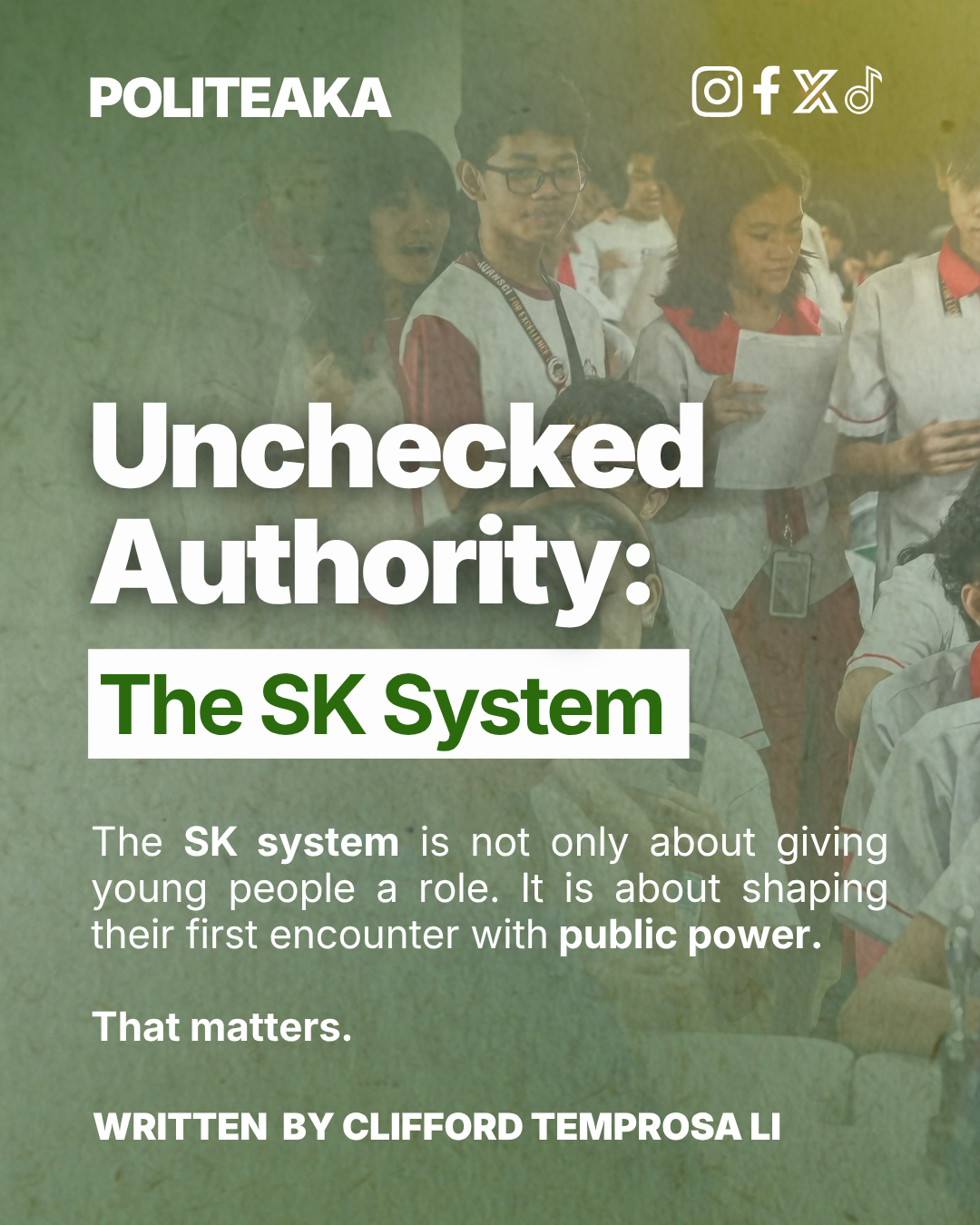
The SK system is not only about giving young people a role. It is about shaping their first encounter with public power.
That matters.
Because the first governance system someone enters does not just teach procedures.
It teaches what power feels like. What accountability requires. What transparency actually means. What consequences look like. What can be questioned. What can be ignored. What becomes normal.
And those lessons stay.
If that first system is structured with weak oversight, inconsistent verification, and unclear consequences, those conditions do not remain contained within SK. They become political training.
They shape how young leaders understand what governance allows, what leadership demands, and what public service can get away with.
So SK is not just a youth engagement platform. It is an early formation system for political behavior.
And if that system teaches leaders to operate inside ambiguity, then ambiguity becomes part of their governance.
If it teaches that visibility matters more than accountability, then performance becomes easier than substance.
If it teaches that funds can move without clear verification, then public resources become easier to treat as flexible.
That is the deeper risk. Because weak systems do not only produce weak outcomes. They produce habits. They produce norms. They produce leaders who carry those norms forward into larger offices, bigger budgets, and higher levels of power.
If we are serious about improving governance, then reform cannot start at the top. It has to start at the first system where power is learned. Because SK is not separate from the political system. It is where that system begins. That means we cannot treat SK as symbolic participation. We cannot treat training as optional. We cannot accept weak accountability as part of the learning process.
Because if the system continues to allow authority without structure, it will continue to produce leaders who learn to operate within those same gaps.
So the question is no longer whether youth are ready to lead.
The question is:
What kind of system are we training them to lead in?
And more importantly….
Are we willing to fix that system before those lessons scale?