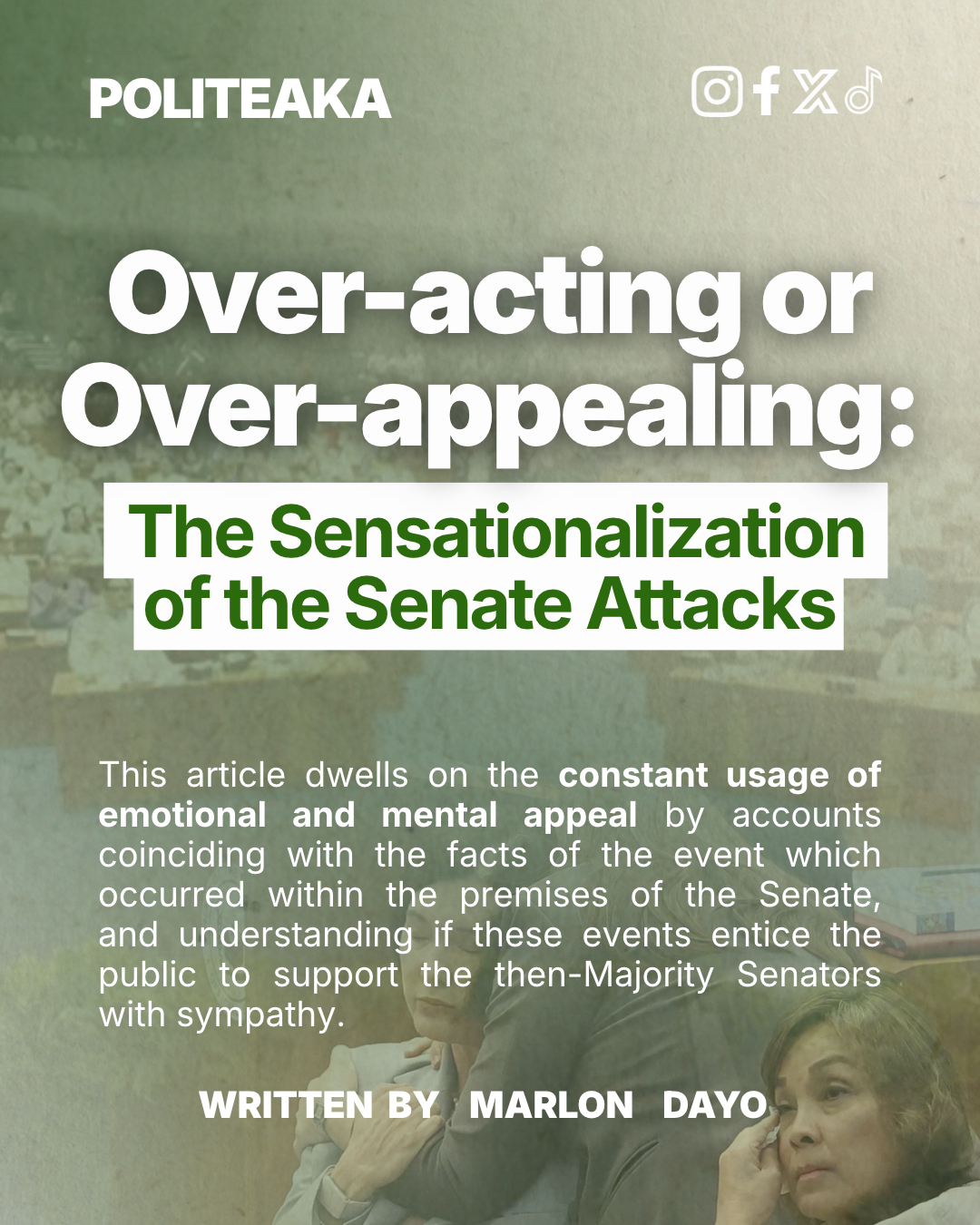
Stability breeds instability. More than once, we have seen things like this in front of any political entity. Be it in government, private, and even in civil society. Long stable rule can lead to instability, even in leadership, where support must be given from the grassroots. Following the events of May 2026, it is more than observed in the Senate where months of stability grew into an unstable environment of changes.
Last May 11, the Senate met a certain twist of support from one leadership to another. Senate coups are never new in the Chamber, as we have seen multiple changes of leadership throughout the past three Congresses for almost two years. Turning tables by then-Majority Senators moving to the Cayetano Bloc made a new majority, most especially with the appearance and vote of Senator Ronald “Bato” Dela Rosa, after his 6-month absence at the Senate, became the highlight of the change during that day. Colloquially, numerical representation of the Senate composition became 13-11 (Majority and Minority Floor, respectively). The rift between the two floors has been evident with the exclusion of Minority Senators from major Senate committee leadership and of how supposed allegiances influence the power dynamics in the chamber.
However, on May 13, the Senate faced an unprecedented event as shots were fired inside the GSIS Building, and the intense climate within the premises has led to the massive intrigue of the people about the shooting. The apparent warning shot was triggered by former Office of the Sergeant-at-Arms (OSAA) Acting Head, Ret. PGEN Mao Aplasca, against the National Bureau of Investigation (NBI) group in the possible arrest of Senator Dela Rosa. However, as clarified by the NBI Director, Melvin Matibag, the presence of the NBI group within the premises was due to the request of GSIS President Jose Arnulfo “Wick” A. Veloso to secure the GSIS Building with the rising threat on the same day of the incident.
At the same time, the new Majority Senators had resorted to announcing the incident through livestreaming in their offices and on their respective Facebook pages, which contributed to thousands of views online. Terms such as “under attack” and “siege” had been used by Senators, which became a highlight in describing the situation at the Senate. News outlets started to use these terms and eventually became a narrative attached to the incident. For more weeks, this has been continuously covered by every outlet, online discussions, and most especially, during the session of the Senate.
With facts being laid on the table, did the Senators overreact, or did they over-appeal to the people? Sure, your overreaction is valid, as anyone would be when a shooting within your vicinity happens. However, with facts being produced by investigations, over-acting for a time seems over-appealing, as if we are trying to push a false narrative already.
Let us discuss everything.
First, the Facebook livestreams and posts, the sensationalization of Senators led to a hysterical moment on social media that brought massive panic and intrigue within the Senate grounds because of a shooting incident. News outlets covered the livestreams of the Cayetano siblings, who claimed that the Senate was under attack, depicting an assailant close to the NBI Agents within the premises. Senator Imee Marcos posted on her Facebook, claiming that the walls of the Senate building are being breached with a drill, which was just construction nearby.
Second, the blaming game between the OSAA and the NBI further muddled public understanding of the incident. Instead of presenting a unified and factual explanation to reassure the public, conflicting narratives emerged from different institutions. The initial assumption that the NBI had entered the premises to arrest Senator Dela Rosa quickly spread across social media and political circles. Yet subsequent clarifications from NBI Director Melvin Matibag revealed that the agency's presence was merely in response to a request from GSIS management to help secure the area amid rising security concerns. The contradiction between the assumptions circulated by political figures and the findings of official investigations only fueled speculation and distrust. In moments of crisis, clarity should prevail over conjecture. Unfortunately, the public was left to sift through competing claims rather than a coherent account of events.
Lastly, the aftermath of the shooting demonstrated how quickly narratives can outlive facts. While investigations gradually clarified the circumstances surrounding the warning shot, public discourse had already been shaped by dramatic descriptions of the event. The portrayal of the Senate as being “under attack” or “under siege” created an image of an institution facing an organized threat rather than a contained security incident. Such framing may have generated public attention, but it also risked distorting reality. When elected officials amplify unverified claims during unfolding situations, they carry a responsibility for the consequences of those statements. Public trust in institutions is weakened when sensational narratives are later contradicted by evidence.
This is not to dismiss the genuine fears that may have been experienced by senators, employees, and visitors present during the incident. Any discharge of a firearm within a government complex is a serious matter that warrants concern and investigation. However, concern should not be mistaken for a license to exaggerate. Public officials are expected to exercise restraint, particularly when their words carry significant influence over public perception.
The events following the Senate leadership change reveal a broader issue beyond a single shooting incident. Political instability does not merely manifest through shifting alliances and changing majorities; it also emerges through the narratives that leaders construct to justify their positions and rally support. In an era where livestreams can reach thousands within minutes, and social media posts can shape public opinion before facts are established, the responsibility to communicate accurately becomes even greater.
Stability breeds instability when institutions become complacent, but instability becomes dangerous when it is amplified through fear and spectacle. The Senate's duty is not only to legislate and provide oversight but also to serve as an example of responsible governance. In the aftermath of the May 13 incident, the greater lesson may not be about who fired the shot or who held the majority, but about how political actors choose to frame events in moments of uncertainty. Facts must remain stronger than narratives, and accountability must prevail over theatrics.